

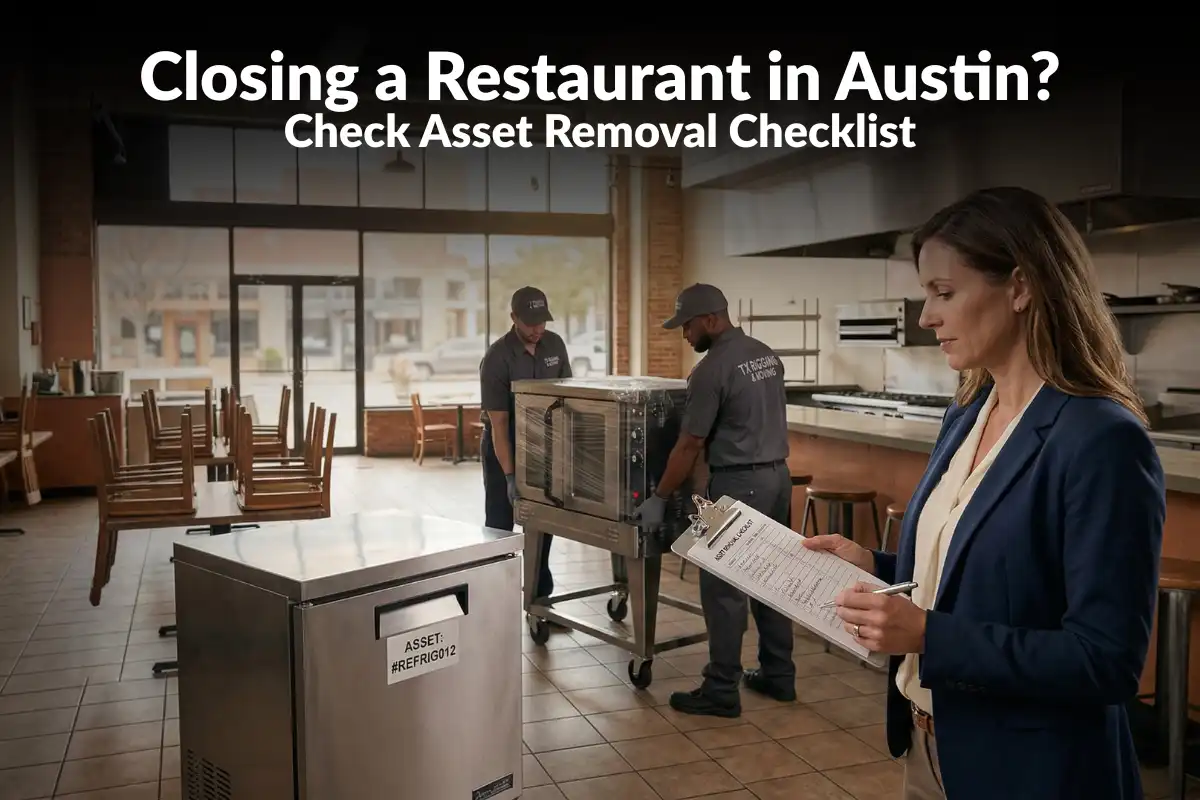
Closing a business in Austin requires four critical phases spanning 30 to 90 days. The restaurant or retail store asset removal checklist starts with legal compliance, including Form 05-305 filing with the Texas Secretary of State and surrendering your TABC license to avoid ongoing tax obligations.
Phase two covers operational shutdown, such as disconnecting Austin Energy commercial service and conducting inventory triage to separate sellable equipment from waste.
Phase three focuses on maximizing return on investment through professional equipment appraisals and online auctions that reach registered buyers nationwide.
The final phase addresses facility logistics, including the make-good clause in your commercial lease and compliance with Austin Resource Recovery’s bulk waste rules.
Without proper planning, you risk losing thousands to landlord penalties, uncollected equipment value, and ongoing permit fees.
Phase 1: Legal Compliance and Texas State Requirements
Skipping legal paperwork leaves your business open and you personally liable for ongoing taxes, fees, and lease obligations even after you stop operating. Texas business owners must formally dissolve their entity with the state and surrender all active permits.
It includes your Sales Tax Permit, TABC alcohol license if applicable, and Austin Health Department permits.
The state tracks businesses through tax identification numbers. If you fail to officially close your entity, the Texas Comptroller will continue assessing franchise tax, and the city will bill for annual permit renewals.
Filing Form 05-305 and Certificate of Termination (Texas Secretary of State)
Form 05-305 officially dissolves your Texas business entity and stops future state tax obligations.
If you operate as an LLC or corporation, you must file a Certificate of Termination with the Texas Secretary of State. Use Form 05-305 for LLCs or Form 651 for corporations. The filing fee is 40 dollars. Before filing, obtain a Certificate of Account Status from the Texas Comptroller showing zero tax balance. It confirms that all sales tax, franchise tax, and mixed beverage tax are paid. Processing takes 3 to 5 business days online or 15 business days by mail. Sole proprietors do not need to file dissolution paperwork with the state, but must still surrender permits and file final tax returns. For closing a restaurant in Austin, this step prevents the state from pursuing you for unpaid taxes years later.
Surrendering Your TABC License & Austin Health Permits
Surrender your TABC license immediately to stop accruing fees and avoid penalties for unrenewed permits.
If your business sells alcohol, you must formally surrender your TABC license in Texas by submitting a Surrender of Permit form to the Texas Alcoholic Beverage Commission. Do this within 30 days of closing to avoid renewal fees. The TABC will issue a final inspection and clear your permit record. Failing to surrender keeps the license active, and you remain liable for compliance inspections.Contact the Austin Public Health permit cancellation division at 512-978-0300 to cancel your food establishment permit. Request a final health inspection to document the condition of your kitchen and avoid future liability if the space is later cited for violations. Also, cancel your Austin Fire permit if you have commercial cooking equipment with hood suppression systems.
Legal Requirements for Liquidating a Business Under Texas UCC Article 9
UCC Article 9 governs how secured creditors get paid when you sell business assets during liquidation.
UCC Article 9 liquidation rules apply when your business owes money to lenders who hold a security interest in your equipment or inventory. Before selling any assets, search the Texas UCC database for active financing statements against your business. If liens exist, lenders must be paid from the sale proceeds before you receive any money. Secured creditors have priority over unsecured creditors, like vendors or landlords. If you sell equipment without satisfying liens, the buyer may lose the equipment when the lender repossesses it. To conduct a compliant business liquidation in Austin, TX, notify all secured parties in writing before selling collateral. Many lenders require written approval for asset sales. Jones Swenson Auctions handles lien searches and creditor notifications as part of our auction process.
Phase 2: Operational Shutdown and Utility Management
Utilities continue billing until you formally disconnect service. Water and electricity can add hundreds of dollars per month, even in an empty building.
Once legal paperwork is filed, shift focus to stopping monthly operating costs. This includes disconnecting utilities, removing inventory, and sorting assets by value. Many owners lose money by treating everything as junk, even though valuable equipment could sell for thousands at auction.
Navigating the Austin Energy Commercial Disconnect Process
Call Austin Energy at 512-494-9400 to schedule commercial service disconnection 5 business days in advance.
The Austin Energy commercial disconnect process requires a final meter reading and payment of the outstanding balance. Schedule disconnection after you finish removing equipment, since auction companies need electricity for lighting and equipment testing.
Provide your account number, service address, and forwarding address for final billing.
If your lease requires you to maintain utilities until the landlord finds a new tenant, negotiate a reduced rate or request that the service be transferred to the landlord’s name after asset removal is complete. Document the disconnection date in writing to prove when you stopped using the space for retail store liquidation in Austin.
Steps for Retail Store Inventory Removal in Central Texas
Sort inventory into sellable goods, donation items, and trash before scheduling bulk removal services.
Retail store inventory removal begins by categorizing stock. Current-season merchandise and unopened products can be sold through liquidation sales or returned to suppliers, if return policies allow. Seasonal or damaged goods work better for donation to nonprofits like Goodwill or The Salvation Army, which provide tax deduction receipts. For restaurant furniture donation in Austin, contact Keep Austin Fed or Caritas of Austin. Both organizations accept commercial kitchen equipment and dining furniture in working condition. Schedule pickup at least two weeks in advance, as nonprofit hauling capacity fills quickly. Donation removes low-value items at no cost while generating tax deductions.
Inventory Triage: Separating High-Value Assets from Junk
High-value assets include working kitchen equipment, point of sale systems, and fixtures less than 10 years old.
Not everything deserves equal attention in your Austin restaurant closure guide. Separate assets into three categories.
- Category A is high-value equipment valued at over $500, such as commercial refrigerators, ovens, espresso machines, and draft beer systems. These items auction well and should never be scrapped.
- Category B includes mid-value items priced from $100 to $500, such as shelving, tables, chairs, and small appliances. Bundle these in auction lots or offer as package deals to maximize return.
- Category C covers items under $100 or broken equipment with no resale value. The category goes to donation or disposal. Walk through your space with a clipboard and mark each item by category before contacting auctioneers or haulers.
Phase 3: The Asset Removal Strategy (Maximizing ROI)
Equipment values drop 20 to 30 percent when sold without documentation or proper marketing to qualified buyers.
The difference between a successful liquidation and leaving money on the table comes down to professional asset handling. Appraisals establish fair market value. Auctions bring competition among buyers. Proper documentation protects you from future disputes.
Why Professional Equipment Appraisals Prevent Financial Loss
Appraisals establish documented values for insurance claims, loan negotiations, and tax deductions on donations.
Professional equipment appraisals serve multiple purposes during retail fixture removal. First, they provide a baseline for auction reserve prices. Without an appraisal, you may accept lowball bids out of desperation.
Second, appraisals support insurance claims if equipment is damaged during removal.
Third, the IRS requires qualified appraisals for donated property valued at over 5,000 dollars. A certified appraiser must be independent and hold credentials such as the Certified Equipment Appraiser designation.
Jones Swenson holds a Graduate Personal Property Appraiser certification and provides written appraisals accepted by lenders and courts. Expect appraisal costs of $ 500 to $ 2,000, depending on inventory size and complexity.
Online Auctions: Best Ways to Reach Registered Buyers for Specialized Fixtures
Online auctions expose your equipment to thousands of registered buyers across multiple states and countries.
Commercial kitchen auctions in Texas work best through hybrid auction formats combining online bidding with physical inspection. Registered buyers pre-qualify with credit checks and tax identification.
It eliminates tire kickers and no-show bidders, common in Craigslist or Facebook Marketplace sales. Auction platforms like Proxibid and BidSpotter reach restaurant equipment dealers, food truck operators, and overseas buyers in Mexico and Central America. Specialized equipment, such as wood-fired pizza ovens or craft brewery systems, attracts niche buyers willing to pay premium prices. To sell used restaurant equipment in Austin, online auctions typically achieve 60 to 80 percent of replacement cost for equipment under 5 years old. Auction timelines run 21 to 30 days from listing to settlement.
Managing Titles and Transfer of Ownership
Provide bills of sale for all equipment and clear titles for any vehicles or trailers sold.
Buyers need proof of ownership to register vehicles or obtain insurance on high-value equipment. For titled assets such as delivery trucks or refrigerated trailers, use Texas Form 130-U, Application for Title, to transfer ownership. Include odometer disclosure if required. Run a UCC lien search before selling to confirm you own the asset free and clear. For non-titled equipment, a notarized bill of sale provides sufficient documentation.
Include equipment serial numbers, make, model, sale price, and date. Both parties sign and date the document.
Buyers often need these records to claim depreciation on tax returns or obtain financing for the purchase. Proper documentation prevents disputes and protects you from liability if equipment malfunctions after the sale.
Phase 4: Facility Logistics and The Make Good Clause
Landlords can withhold your security deposit and charge thousands in penalties if you fail to return the space in the agreed-upon condition.
The final phase of your restaurant or retail store asset removal checklist addresses preparing your space for handback to the landlord.
It includes removing all equipment, repairing damage, and cleaning to meet lease requirements.
Who Handles Heavy Machinery Removal for Austin Business Closures?
Licensed auction companies and commercial riggers handle the removal of equipment over 500 pounds.
Heavy commercial equipment, such as walk-in coolers, industrial dishwashers, and brick ovens, requires specialized removal.
Amateur attempts to damage walls, floors, and plumbing. Landlords charge repair costs against your security deposit. Professional riggers carry liability insurance covering property damage during removal.
Jones Swenson Auctions includes equipment removal as part of our auction services. We coordinate with licensed riggers to safely extract built-in equipment and repair cosmetic damage. It prevents landlords from claiming you violated your lease make-good clause.
Removal costs typically run 500 to 2,000 dollars, depending on equipment size and building access.
Schedule removal during the auction process so buyers can pick up purchases immediately after the sale ends.
Austin Resource Recovery Rules for Bulk Waste & Donation
Commercial properties must schedule bulk waste pickup through private haulers, not city collection services.
Austin Resource Recovery business rules prohibit commercial entities from using curbside bulk waste collection.
You must hire a private waste hauler for furniture, broken equipment, and construction debris. Popular options include Texas Disposal Systems and Waste Management, which offer dumpster rental and scheduled pickups.
For commercial waste disposal in Austin, expect costs of 300 to 800 dollars for a 30-yard dumpster rental.
Many haulers charge extra for items containing refrigerants, such as air conditioners and freezers, due to EPA disposal requirements. Schedule waste removal after auction pickup is complete to avoid throwing away sellable items.
Checklist for Returning a Commercial Lease to Broom-Clean Condition
Broom clean means swept floors, no trash, no personal property, and all utilities disconnected per the lease.
Most commercial leases require tenants to return the space in broom-clean condition unless the lease specifies complete restoration to original condition.
Broom clean typically means:
- All personal property and equipment removed.
- Floors swept and mopped.
- Trash and debris hauled away.
- Light fixtures and HVAC filters cleaned.
- Keys returned to the landlord.
- Utilities transferred or disconnected.
Document the final condition with photos and video showing compliance. Schedule a walk-through inspection with your landlord before returning keys. Get written acknowledgment that the space meets lease requirements. This prevents disputes over security deposit refunds. If your lease requires deeper cleaning or restoration work, such as repainting or carpet replacement, hire professional contractors and save the receipts.
Timeline Planning: How Long Does Asset Removal Actually Take?
Rushing asset removal can lead to underselling equipment or missing deadlines, triggering lease penalties.
Plan 60 to 90 days from decision to close until final key handoff. Week one covers legal filings and permit surrenders.
Week two through four involves equipment appraisals, auction setup, and marketing. The auction runs 7 to 10 days with pickup scheduled immediately after close. Week five through seven handle waste removal, cleaning, and lease restoration. This timeline assumes no complications. Add two weeks if dealing with secured creditors or complex leases requiring extensive restoration.
Compressing the timeline below 45 days risks accepting low auction prices or failing to properly document the closure.
Cost Summary: What to Budget for Your Austin Closure
Hidden closure costs quickly exceed $10,000 if not planned properly.
Budget for state filing fees of 40 dollars, equipment appraisal of $500 to $2,000, auction commission of 10 to 15 percent of sale proceeds, waste removal of $300 to $800, and utility final bills of 200 to 500 dollars. Add cleaning and minor repairs totalling $500 to $1,500 to meet lease requirements.
| Expense Category | Typical Cost Range |
| State Filing Fees | 40 dollars |
| Equipment Appraisal | 500 to 2,000 dollars |
| Auction Commission | 10 to 15 percent of sales |
| Waste Removal | 300 to 800 dollars |
| Heavy Equipment Removal | 500 to 2,000 dollars |
| Cleaning and Repairs | 500 to 1,500 dollars |
| Total Estimated Cost | 2,840 to 7,340 dollars |
These costs exclude lease penalties for early termination or damage repairs beyond normal wear and tear.
Proper planning through your restaurant or retail store asset removal checklist minimizes unexpected expenses and maximizes equipment recovery value.
Common Mistakes That Cost Business Owners Thousands
Simple mistakes turn manageable closures into financial disasters.
Mistake one is abandoning equipment in place, hoping the landlord will deal with it. Leases make you responsible for removal, regardless of the equipment’s value. Landlords charge professional removal fees plus penalties. Mistake two is accepting the first cash offer without shopping around. Equipment dealers’ lowball offers, knowing that desperate sellers will accept anything. Mistake three is selling equipment with active liens without creditor approval. This violates UCC Article 9 and exposes you to lawsuits. Mistake four is failing to document the space’s final condition. Without photos proving a broom-clean delivery, landlords withhold deposits, claiming damage. Finally, mistake five is waiting until after the lease expires to start the removal process. This triggers holdover rent charges that can double your monthly payment.
Why Professional Help Pays for Itself
Closing a business is hard enough without having to navigate complex regulations and logistics alone. Professional auction companies handle every step from lien searches to final cleanup. The commission paid on equipment sales is recovered through higher auction prices and avoided mistakes.
Jones Swenson Auctions has guided hundreds of Texas business owners through closures since 1983.
We handle the restaurant or retail store asset removal checklist so you can focus on your next chapter. Our services include lien searches, creditor notifications, professional appraisals, online auction marketing, equipment removal, and final site cleanup.
For more detailed guidance on navigating landlord negotiations and lender obligations, you must learn how to close your Texas Restaurant without losing thousands to your landlord or lenders.
Ready to discuss your specific situation?
Contact us today for a free consultation on maximizing your asset recovery while minimizing closure headaches.
Frequently Asked Questions
How long does the restaurant liquidation process take in Austin?
Most restaurant liquidations take 60 to 90 days from decision to final key handoff.
How long does the entire asset removal and auction process typically take?
Asset removal and auction typically takes 45 to 60 days, including marketing and buyer pickup.
Can I abandon equipment I do not want in the leased space?
No. Your lease requires the removal of all personal property, or you will face penalties and deposit forfeiture.
Do I need a specific permit to move heavy commercial equipment in downtown Austin?
Large equipment removal may require street-closure permits if it blocks traffic or sidewalks during loading.
Do I need a professional appraisal before liquidating my store assets?
Appraisals are recommended for insurance claims, tax deductions on donations, and setting auction reserve prices.
What is the legal benefit of choosing business liquidation over Chapter 7 bankruptcy in Texas?
Liquidation avoids bankruptcy fees, protects credit scores, and gives you control over asset sales.


