

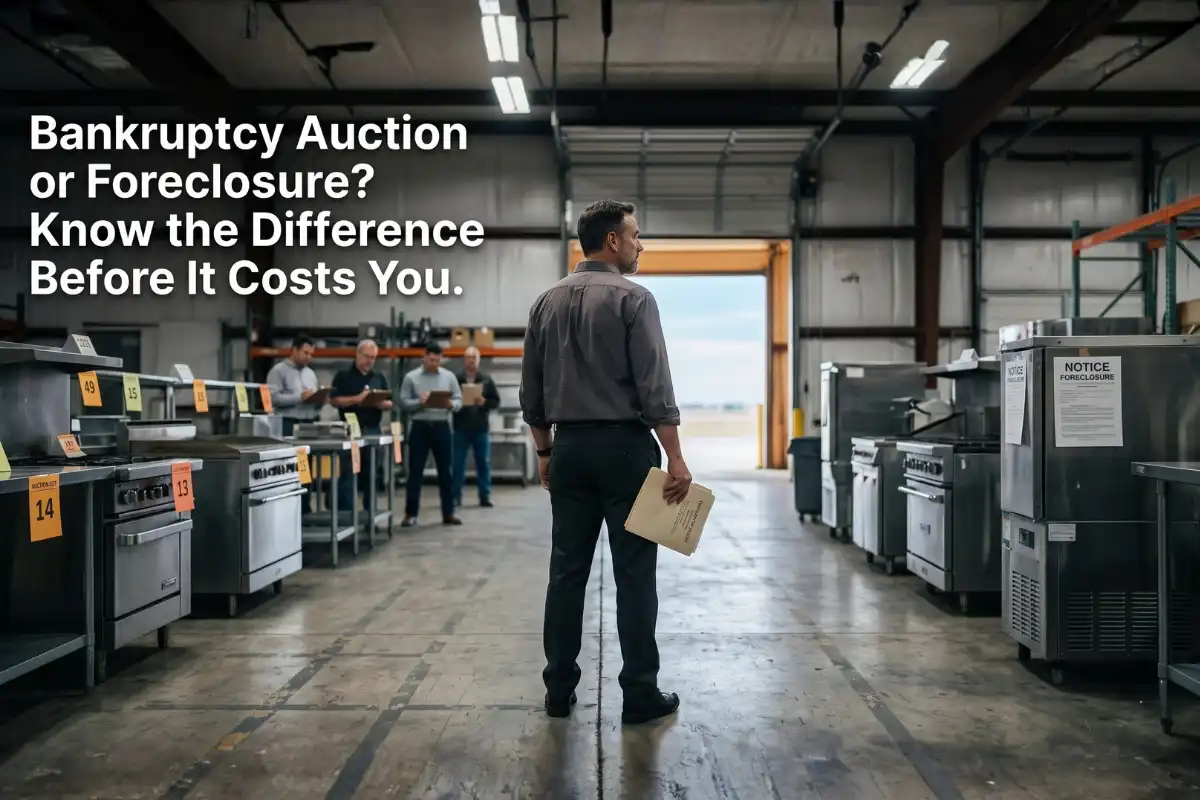
Bankruptcy Auctions vs. Foreclosure Sales two paths no business owner plans for, yet many eventually face.
When financial pressure builds, the way you handle asset recovery can decide whether you minimize losses or walk away with lasting damage.
In Texas, the rules, timelines, and outcomes of these two processes are very different. One is controlled by the court. The other is driven by lenders. Both can impact your business, your assets, and your future opportunities.
What many owners don’t realize is that timing, legal structure, and sale strategy can significantly change how much value you recover. Even small decisions early in the process can lead to major financial differences later.
Understanding how each works isn’t just helpful it’s essential.
This guide breaks down the key differences, risks, and strategies so you can make smarter decisions and protect your return when it matters most.
What is the Main Difference Between a Bankruptcy Auction and a Foreclosure?
At a high level, the difference between bankruptcy and foreclosure for businesses in Texas comes down to control and purpose.
A bankruptcy auction is part of a legal process where a court oversees the sale of assets to repay creditors. A foreclosure sale, on the other hand, allows a lender to seize and sell assets when a borrower defaults.
Here is quick overview of the key difference between a bankruptcy auction and foreclosure sale?
| Factor | Bankruptcy Auction | Foreclosure Sale |
| Control | Managed by the court through a trustee | Controlled by the lender |
| Primary Goal | Fair distribution to all creditors | Recover debt for a specific lender |
| Legal Process | Governed by bankruptcy law and court oversight | Governed by loan agreements and UCC laws |
| Decision Authority | Court-appointed trustee makes decisions | Lender makes decisions |
| Speed of Process | Usually slower due to court procedures | Typically faster and more direct |
| Asset Pricing | Often lower due to urgency (“fire-sale”) | May vary but focused on debt recovery |
| Transparency | High (public auctions, court approval) | Moderate (depends on lender process) |
| Creditor Involvement | Multiple creditors involved | Usually one primary secured creditor |
| Flexibility | Limited flexibility due to legal rules | More flexible for lender actions |
| Outcome Focus | Balanced repayment across creditors | Maximizing recovery for lender |
Defining the Bankruptcy Auction: The Trustee’s Role
In a bankruptcy case, assets are typically sold through Court-Appointed Trustee Sales, which are structured legal processes supervised by the bankruptcy court. A trustee is appointed to manage the entire liquidation process on behalf of the estate and creditors.
The trustee’s role is not just administrative—it is legally fiduciary, meaning they must act in the best interest of all creditors collectively rather than favoring any single party.
Key Responsibilities of a Trustee
- Take control and secure the debtor’s business assets
- Assess and determine the fair value of assets before sale
- Organize and oversee the sale or auction process
- Distribute proceeds among creditors according to legal priority
How the Process Works
- Assets are sold through public auctions or structured bidding processes
- Buyers compete through transparent, court-monitored bidding
- Final sales often require court approval to ensure fairness and compliance
Because the process is time-bound and legally regulated, assets are often sold quickly, which can create pricing pressure. This is why buyers evaluating buying business assets at a bankruptcy auction vs foreclosure often see stronger opportunities for discounted acquisitions.
Defining the Foreclosure Sale: The Lender’s Recourse
A foreclosure sale operates under a completely different structure because it is driven by the lender rather than the court system.
When a borrower defaults on a secured loan, the lender enforces its rights under Secured Creditor Rights in Texas to recover the outstanding debt by seizing and selling the pledged collateral.
Legal Framework Behind Foreclosure
- Loan agreements that define repayment obligations
- Security agreements that establish collateral rights
- Texas UCC Article 9 Liquidation rules governing commercial asset recovery
Unlike bankruptcy, foreclosure does not aim to balance the interests of multiple creditors. Instead, it is focused on one objective: recovering the unpaid debt owed to the secured lender as efficiently as possible.
Because of this narrow focus, lenders often prioritize speed, compliance, and debt recovery over maximizing asset value. In many cases, this leads to faster sales processes, limited marketing exposure, and outcomes that reflect recovery value rather than full market potential.
Navigating the Bankruptcy Process: When the Court Takes Control
Once a business files for bankruptcy, the entire financial control shifts from the owner to the bankruptcy court. This transition is significant because it changes how decisions are made regarding assets, operations, and creditor payments. From this point forward, every major action must follow strict legal oversight to ensure fairness in the distribution process.
The court appoints a trustee (in most cases) to manage the estate, evaluate assets, and coordinate sales. This ensures that no single creditor has unfair advantage and that all proceedings align with bankruptcy law. However, this structure also limits the business owner’s ability to make independent decisions about timing, pricing, or asset disposal.
At the same time, creditors become legally bound by the court’s rules, meaning they must wait for structured resolution rather than pursue individual recovery actions. This creates a controlled but slower environment compared to foreclosure.
In this stage, asset liquidation is no longer just a financial decision—it becomes a legal process designed to balance competing creditor interests under court supervision.
The Automatic Stay: How Filing Stops Foreclosure Temporarily
One of the most important protections in bankruptcy is the automatic stay, which takes effect immediately after a bankruptcy petition is filed. This legal mechanism temporarily halts most collection activities, including lawsuits, wage garnishments, and foreclosure proceedings.
For business owners, it creates a critical pause in financial pressure, allowing time to reorganize or plan asset recovery without immediate enforcement actions from creditors.
In practical terms, the automatic stay prevents lenders from continuing a foreclosure process on secured assets, even if default has already occurred.
This is especially relevant for businesses asking, does bankruptcy stop a commercial foreclosure in Austin? because in most cases, it does, at least temporarily.
However, the stay is not absolute or permanent. Secured creditors can file a motion with the court to lift the stay if they can demonstrate insufficient protection of their collateral or lack of equity in the asset. If approved, foreclosure or recovery actions may resume under court permission.
This balance between protection and creditor rights ensures that bankruptcy does not erase obligations but instead regulates how and when enforcement can proceed.
Why Bankruptcy Auctions Often Result in “Fire-Sale” Prices
Bankruptcy auctions often lead to lower-than-market pricing because the sale environment is driven by urgency, legal deadlines, and asset liquidation requirements rather than long-term value optimization. Once assets enter bankruptcy proceedings, the primary goal is to convert them into cash quickly to satisfy creditor claims, not to maximize resale value.
In most cases, marketing time is limited, buyer negotiation power is reduced, and assets are sold “as-is” under court supervision. This creates conditions where bidders expect discounts, especially when assets are part of distressed estates.
As a result, pricing often aligns closer to Orderly Liquidation Value (OLV) rather than full Fair Market Value, particularly for specialized business equipment or inventory.
Another factor is perception. Buyers often assume bankruptcy assets may come with hidden risks, incomplete maintenance history, or operational uncertainty, which further suppresses bidding competition. Even when assets are fully functional, the bankruptcy context alone can reduce perceived value in the marketplace.
This combination of urgency, limited exposure, and buyer caution explains why bankruptcy auctions frequently produce “fire-sale” outcomes compared to more structured liquidation methods.
Chapter 7 vs. Chapter 11: Impact on Asset Liquidation Timelines
The timeline and outcome of asset liquidation in bankruptcy largely depend on whether the case is filed under Chapter 7 or Chapter 11, as each follows a different legal and operational structure. Understanding this distinction is essential for evaluating how quickly assets are sold and how much value can realistically be recovered.
Under Chapter 7 bankruptcy, the business is typically shut down, and a court-appointed trustee immediately begins liquidating assets. This process is designed for speed and debt repayment, meaning assets are sold relatively quickly, often through auctions or bulk sales. While efficient, this accelerated timeline usually results in lower recovery values due to limited marketing and negotiation time.
In contrast, Chapter 11 bankruptcy is focused on restructuring rather than immediate closure. The business may continue operating while it reorganizes its debts, and asset sales are often more strategic and gradual.
This extended timeline allows for better market exposure and potentially higher returns, but it also involves more legal complexity and ongoing court supervision.
Ultimately, the choice between Chapter 7 and Chapter 11 directly affects liquidation speed, asset valuation outcomes, and creditor repayment priorities.
Understanding Foreclosure Sales: Protecting Secured Assets in Texas
Foreclosure sales in Texas are designed to allow lenders to recover unpaid debts by taking control of specific pledged assets when a borrower defaults. Unlike bankruptcy, where multiple creditors are involved, foreclosure is typically a direct enforcement action between a lender and a borrower under a secured loan agreement. The process is heavily guided by contractual terms and state laws, especially those related to secured transactions.
In most business cases, foreclosure is triggered when collateral such as equipment, inventory, or property is used to secure financing. Once default occurs, the lender moves to enforce their rights and recover value from the pledged assets as efficiently as possible. This is where Secured Creditor Rights in Texas and related legal frameworks determine how the process must be conducted.
Foreclosure is not just about seizure—it also involves proper notice, valuation, and sale execution to ensure compliance with Texas UCC Article 9 Liquidation standards. These requirements ensure that while lenders can recover debts, the process remains commercially reasonable and legally enforceable.
UCC Article 9: The Legal Framework for Equipment Foreclosure
Most business asset foreclosures in Texas are governed by Texas UCC Article 9 Liquidation, which provides the legal structure for secured transactions involving business collateral. This framework defines how lenders can enforce their security interest when a borrower defaults, especially for movable assets such as machinery, equipment, inventory, and vehicles.
Under Article 9, a lender who holds a valid security interest has the right to take possession of the collateral and dispose of it through a commercially reasonable sale. However, this right is not unlimited. The lender must follow strict legal requirements to ensure fairness and transparency throughout the foreclosure process.
Key Requirements Under UCC Article 9
- Provide proper notice to the debtor and relevant parties before sale
- Ensure the sale method is commercially reasonable in timing, pricing, and marketing
- Apply all sale proceeds toward the outstanding secured debt
- Account for any surplus or deficiency after the sale
For business owners, understanding this framework is critical when dealing with how to sell business equipment with a UCC lien, as it directly impacts both timing and recovery value. It also plays a key role in determining how disputes are handled between lenders and borrowers during asset liquidation.
In practice, Article 9 ensures lenders can recover debts efficiently while still maintaining legal safeguards for borrowers, balancing enforcement rights with procedural fairness.
Real Estate vs. Business Personal Property Foreclosures
Foreclosure processes in Texas vary significantly depending on the type of asset involved. Real estate assets and business equipment are not treated the same under the law, and the recovery process, timeline, and enforcement rules differ accordingly. Understanding this distinction is essential for business owners dealing with secured lending, especially when multiple asset types are pledged as collateral.
Below is a clear breakdown of how these two foreclosure types compare in practice.
Real Estate vs. Business Personal Property Foreclosure (Comparison)
| Factor | Real Estate Foreclosure | Business Personal Property Foreclosure |
| Asset Type | Land, commercial buildings, offices, warehouses | Equipment, machinery, inventory, vehicles |
| Governing Law | State property laws, deed of trust regulations | Texas UCC Article 9 Liquidation |
| Process Speed | Generally slower due to legal notice periods | Faster due to streamlined repossession rules |
| Enforcement Method | Public auction after statutory procedures | Repossession followed by commercially reasonable sale |
| Lender Control | Moderate, regulated by court and state rules | High, subject to security agreement terms |
| Valuation Approach | Market-based appraisal and bidding | Often based on liquidation value of assets |
| Notice Requirements | Strict statutory notice timelines | Required but generally shorter notice periods |
| Common Buyers | Real estate investors, developers | Equipment dealers, resellers, auction buyers |
| Typical Recovery Speed | Weeks to months | Days to weeks |
| Example Scenario | Sale of a commercial warehouse after default | Sale of restaurant kitchen equipment after loan default |
Deficiency Judgments: What Happens if the Sale Doesn’t Cover the Debt?
In many foreclosure cases, the sale of collateral does not fully satisfy the outstanding loan balance. When this happens, the remaining unpaid amount is not automatically forgiven. Instead, it may lead to what is known as a deficiency judgment, which allows the lender to pursue the borrower for the shortfall.
This situation is common in both real estate and business asset foreclosures, especially when market conditions reduce sale prices below expected recovery levels. After the collateral is sold under Secured Creditor Rights in Texas, the lender applies the proceeds to the debt, but any remaining balance becomes the borrower’s continued obligation unless otherwise negotiated or legally discharged.
Key Outcomes of a Deficiency Judgment
- The lender may file a legal claim for the remaining debt
- The borrower may be personally or business-liable depending on loan structure
- Additional collection actions may follow, such as liens or enforcement proceedings
This raises important questions for business owners, including who has priority in a Texas business foreclosure, as payment distribution typically follows a strict order—secured creditors are paid first, followed by unsecured creditors if funds remain.
Understanding deficiency risk is critical because it directly affects long-term financial exposure. Even after assets are sold, liability may continue unless the debt is fully resolved through settlement, restructuring, or bankruptcy protection.
Voluntary Liquidation vs. Forced Sales: Protecting Your ROI
Not all business exits are forced by lenders or courts. In many cases, owners have the option to choose voluntary liquidation, which is a controlled process designed to maximize asset value before financial conditions worsen.
This approach is often compared directly with foreclosure or bankruptcy auctions because it significantly impacts final recovery outcomes.
In a forced sale scenario, assets are typically sold under time pressure, legal constraints, and limited marketing exposure. This often reduces competitive bidding and leads to lower returns.
In contrast, voluntary liquidation allows the business owner to plan the sale, prepare assets for the market, and target the right buyers, which can significantly improve pricing outcomes.
Why Voluntary Business Liquidation Offers Higher Returns than Foreclosure
Voluntary liquidation generally produces better financial results because the owner retains control over timing, marketing strategy, and asset presentation. Unlike foreclosure, where lenders prioritize debt recovery speed, voluntary sales focus on value optimization.
Key advantages include:
- Ability to choose optimal sale timing
- Broader marketing reach to attract competitive buyers
- Better asset preparation and bundling strategies
- Reduced urgency-driven price depreciation
This approach is especially relevant for owners exploring how to maximize ROI during a forced business sale, as early voluntary action often prevents assets from being heavily discounted in distressed markets.
The Role of Professional Appraisals in Setting “Value Floors”
A critical component of voluntary liquidation is establishing a realistic baseline value before assets enter the market. Professional appraisals help determine this “value floor,” ensuring assets are not sold below their true market potential.
Appraisals typically consider:
- Current market demand for similar assets
- Condition, age, and usability of equipment
- Industry-specific pricing trends
- Orderly Liquidation Value (OLV) versus Fair Market Value (FMV)
This valuation process is essential in preventing undervaluation during sales and helps align buyer expectations with real market conditions.
Jones Swenson’s Global Marketing System: Reaching Registered Buyers
Market reach plays a major role in liquidation outcomes. Limited exposure often results in lower bids, while broader buyer access increases competition and pricing strength. Structured marketing systems help solve this gap by connecting assets with qualified, pre-verified buyers.
Platforms like Jones Swenson’s global marketing system focus on:
- Targeted outreach to registered equipment buyers
- International and regional buyer networks
- Competitive bidding environments
- Faster asset turnover with improved pricing outcomes
This structured approach helps bridge the gap between distressed sales and market-based valuations, improving recovery results even in time-sensitive situations.
End Words – Bankruptcy Auctions vs. Foreclosure Sales in Texas
Understanding Bankruptcy Auctions vs. Foreclosure Sales is critical for any Texas business owner facing financial distress or asset liquidation. While both processes ultimately aim to recover value from business assets, they operate under very different rules, timelines, and levels of control.
Bankruptcy auctions are court-supervised and designed to ensure fair distribution among creditors, but they often come with strict timelines and lower realized values due to urgency. Foreclosure sales, on the other hand, are lender-driven and focused on recovering a specific debt, which can lead to faster outcomes but may still leave business owners exposed to deficiency risk.
In both cases, the outcome is heavily influenced by timing, asset preparation, and the chosen liquidation strategy. Exploring alternatives such as voluntary liquidation, professional appraisal support, and structured marketing systems can significantly improve recovery outcomes and reduce financial loss.
For business owners looking to better understand structured liquidation strategies and asset recovery planning, you may also find our guide on Voluntary Liquidation Strategies for Texas Businesses helpful in making more informed decisions before reaching a forced sale scenario.
Ready to discuss your specific situation?
Contact us today for a free consultation on maximizing your asset recovery while minimizing closure headaches.
Some Common FAQs on Bankruptcy Auctions vs. Foreclosure Sales in Texas
01. Does a foreclosure sale count as a “broom-clean” handover?
A foreclosure sale does not automatically guarantee a “broom-clean” handover. The condition of assets depends on the type of collateral, sale agreement, and enforcement terms. In most cases, especially under Texas UCC Article 9 Liquidation, assets are sold on an “as-is, where-is” basis, meaning the buyer accepts the condition at the time of sale without cleanup obligations from the seller or lender.
02. Can I choose my own auctioneer during a bankruptcy proceeding?
In most bankruptcy cases, you cannot directly choose your own auctioneer. The sale process is typically managed by a court-appointed trustee, who selects auctioneers or liquidation firms through approved procedures. This ensures neutrality, compliance, and fair market exposure under Court-Appointed Trustee Sales guidelines.
03. How do UCC liens affect my ability to close my Texas entity?
UCC liens can significantly delay or complicate business closure in Texas. Before dissolving a company, all secured obligations tied to Texas UCC Article 9 Liquidation must typically be resolved, released, or satisfied. If liens remain active, the Texas Secretary of State may not fully process entity termination until the obligations are addressed.
04. What is the “hassle-free” alternative to a forced foreclosure?
The most common alternative to foreclosure is voluntary liquidation, where the business owner proactively sells assets before lender enforcement begins. This approach helps maintain control over pricing, timing, and buyer selection, often resulting in better recovery and fewer legal complications compared to forced sales.
05. What is the difference between bankruptcy and foreclosure for businesses in Texas?
The main difference between bankruptcy and foreclosure for businesses in Texas lies in control and purpose. Bankruptcy is a court-supervised process that addresses all debts and creditors collectively, often involving asset liquidation or restructuring under legal protection. Foreclosure, on the other hand, is initiated by a secured lender to recover a specific unpaid debt by seizing and selling the collateral tied to that loan.
06. Who has priority in a Texas business foreclosure?
In a Texas business foreclosure, secured creditors with perfected liens under Texas UCC Article 9 Liquidation are paid first from the sale proceeds. Unsecured creditors are only paid if any funds remain after secured debts are satisfied. If proceeds are insufficient, the lender may pursue a deficiency balance against the borrower.


