
To choose an auction partner for a factory liquidation, you must evaluate candidate firms on their industry-specific equipment experience, buyer outreach strategy, site removal management, and verified state licensing and credentials.
Selecting a full-service industrial equipment auction partner ensures that every phase, from targeted marketing to utility disconnects and final facility handover, is managed under strict operational deadlines.
Understanding how an industrial equipment auction works is key to making this decision. Unlike simple online listing platforms, a true liquidation auction partner acts as an end-to-end project manager.
On sale day, open bidding establishes fair market value, after which the auction firm manages payment settlement, buyer rigging schedules, and site clearing to ensure you meet your firm exit date.
What an Auction Partner Does in a Plant Liquidation
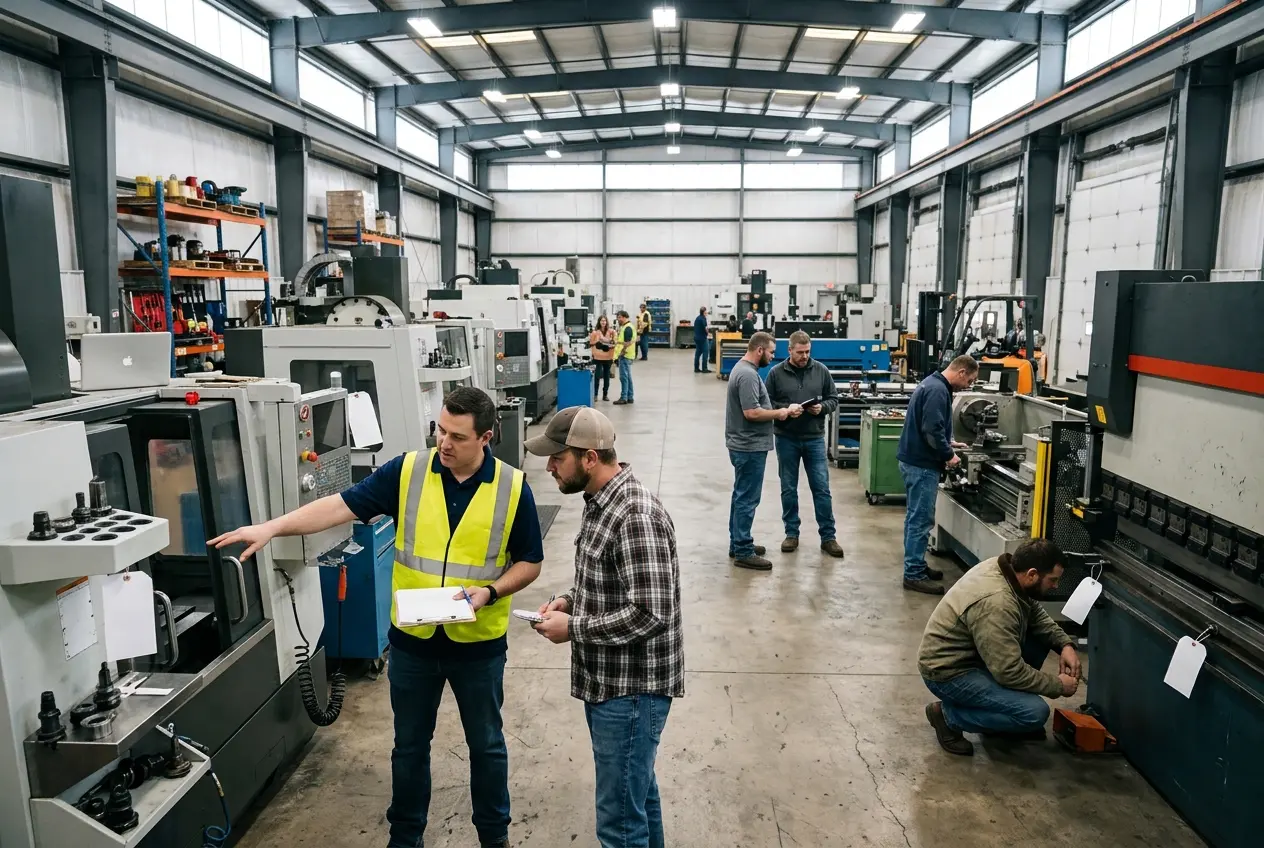
An auction partner runs your whole project, from the first walk-through to the last truck out the gate. A bidding platform only lists items and takes bids. That gap matters when a building must be empty by a set date.
A true industrial auction company builds a buyer list, markets the sale, runs the bidding, collects payment, and manages removal.
In a plant liquidation, removal often decides how smooth your exit feels.
The industrial equipment auction process follows that full path, and any firm you hire should too.
Think of it as hiring a project manager who also sells. You are buying judgment, reach, and follow-through, not a website listing.
Define Your Deadline, Assets, and Goal Before You Compare
Write down three things before you talk to any firm: the date you must be out, what you own, and what matters most.
Those answers shape every proposal you will see. Without them, every firm sounds the same.
Hard Dates and Who Controls the Timeline
Start with the date that cannot be moved. It might come from a lease end, a loan term, a building sale, or a court order.
Sellers range from single-site manufacturers to multi-plant companies, and sometimes a lender, landlord, trustee, or court holds the clock.
Tell every firm that controls the date, because it sets how much time you have to market the sale.
Full Closure or Partial Surplus
A full closure requires a firm that can handle machinery, tooling, forklifts, office equipment, and sometimes the building itself. Partial surplus work is lighter and can run around live production. If you are liquidating a whole facility, say so early. It changes the crew, the schedule, and the cost.
Maximum Recovery, Speed, or Certainty
You rarely get all three. Rank them one, two, and three before you meet anyone. A seller who wants top dollar can wait for a longer marketing window. A seller who needs a firm exit date should accept some price risk in return for speed. Put your ranking at the top of your scorecard.
Is Auction the Right Method for Every Asset?
No. Auction works best when you have many items, a firm deadline, and a buyer market that can set prices through open bidding.
Other methods win in narrower cases. An honest partner will tell you which items belong somewhere else.
| Method | Best for | Main tradeoff |
| Auction | Mixed equipment, firm deadlines, open price discovery | The final price is not known in advance |
| Negotiated sale (private treaty sale) | One specialized line that a single buyer wants | Smaller buyer pool, and the price depends on one negotiation |
| Consignment | Newer, high-value units when time is not tight | Slow, and money arrives only after each unit sells |
| Dealer buyout | Speed and one check | The dealer must resell at a profit, so your price is lower |
Many plants use a mix. One special line might go to a single buyer, while the rest of the floor goes to auction.
If you are weighing a dealer route for newer machines, this auction versus consignment comparison covers the cost side.
Heads Up: Be wary of any firm that says an auction fits everything before it has seen your equipment.
How to Choose an Industrial Auction Company: 8 Criteria That Matter

These eight criteria are ranked by the amount of money and risk each entails. Buyer reach and fees move your proceeds the most.
Removal and settlement protect you from late surprises. Each section gives the answer first, adds specifics, and ends with one question to ask.
Industrial Experience With Your Equipment
Choose a firm that has sold equipment like yours, not just general business assets. Machine tools, presses, packaging lines, and process equipment each draw different buyers.
A firm that knows CNC machines may not know your extrusion line.
Ask for the equipment types, plant sizes, and states of its past industrial sales. Specific answers show real experience. Vague answers show a firm that will learn on your time.
Try This: “Which recent sales look most like my plant.
Buyer Reach and Marketing Plan
The right firm shows you who will see your sale and how. Reach drives price, because more qualified bidders push bids higher.
Ask for the plan in writing, including email lists by industry, equipment marketplaces, search ads, direct calls to known buyers, and the budget for each.
A timed online auction can draw bidders from many states and countries, but only if the right people hear about it. A promise of “worldwide exposure” proves nothing. Named channels and a set budget do.
Try This: “Which buyer groups will you contact for my equipment, and through which channels?”
Valuation and Appraisal Credentials
Pick a firm that can explain what your equipment is worth under different sale conditions. Two terms matter here. Orderly liquidation value is the amount the equipment would bring when sold over a reasonable marketing period.
Forced liquidation value is what it brings when the sale must happen fast, with less time to find buyers. The gap can be large, and your deadline decides which one applies to you.
Look for USPAP equipment appraisal work, since USPAP sets the ethics and method rules appraisers follow.
Credentials such as CAI (Certified Auctioneers Institute) and GPPA (Graduate Personal Property Appraiser) show training in both selling and valuing. Your lender may also need a formal equipment appraisal for its file.
Fees and Net Proceeds
Compare what lands in your account, not the headline rate. A lower auction commission can still cost you more if the firm draws fewer bidders.
Ask for every cost in writing, including commission, marketing charges, removal fees, and any buyer’s premium. Buyers pay that premium on top of their bid, and it can change how high they go. Commission rates also tend to shift with the size of the sale.
This illustrative example shows why net matters more than rate. It omits other fees to keep the math clear and does not reflect any firm’s actual rates.
| Topic | Company A | Company B |
| Sale total | $400,000 | $450,000 |
| Commission rate | 10% | 12% |
| Commission | $40,000 | $54,000 |
| Net to seller | $360,000 | $396,000 |
Company B charges the higher rate and still nets you $36,000 more, because a stronger buyer reach lifted the sale.
Try This: “Can you show projected net proceeds after every fee, in writing?”
Licensing, Insurance, and References
Verify before you trust. Look up the auctioneer’s license with the regulator in the state where the sale will happen. In Texas, that is the Texas Department of Licensing and Regulation (TDLR).
Next, request a certificate of insurance and check the coverage dates. Then call two references from similar plants. Ask what went wrong, not just what went right. Did the firm hit its dates? Did the final bill match the proposal? Would they hire it again?
Try This: “Please send your license number, your insurance certificate, and two references from plants like mine.”
Removal, Site Exit, and Unsold Items
Treat removal as a contract term, not a favor. Many sales stumble here because buyers need time, tools, and access to pull heavy machines.
Your contract should say who handles equipment removal and rigging, who disconnects utilities, how buyers book pickup times, and what condition the building must be in at handover.
Most equipment is sold as-is, where-is, meaning buyers take it in its current condition and location. That makes clear removal rules even more important.
The contract should also say what happens to unsold lots. At Jones Swenson, staff try to sell unsold items by private treaty during the removal period. Ask any firm for its own answer. For hazardous materials, bring in specialist handlers and ask who will manage that work. Do not leave it to guesswork.
Try This: “Who rigs, who disconnects utilities, and on what date does your responsibility for the building end?”
Settlement, Title, and Reporting
Know exactly when and how you get paid. Ask when buyers must pay, where the funds are held, and how many days it takes for the money to reach you.
Jones Swenson typically settles within 10 to 12 business days, and you should confirm timing in any contract you sign. Also, ask who collects sales tax and who handles title paperwork for trucks and trailers.
Finally, request sample reports. Bidder activity, lot-by-lot results, and a final accounting matter, because lenders and trustees often ask for them.
Try This: “What reports do I receive, and on what dates?”
Who Will Actually Run Your Project
Ask for the name of the person who will be on site, not just the person selling the job. Find out who handles valuation, who runs removal, and which parts go to subcontractors.
Subcontracting is not always bad; hidden subcontracting is. You want one accountable lead and a clear list of who does what.
Try This: “Who is my day-to-day lead, and which tasks do you hand to outside crews?”
Questions to Ask Every Auction Company You Interview
Use the same questions with every firm so the answers are easy to compare. Short, direct questions get short, direct answers.
Experience
- Which recent plant sales look most like mine?
- Who will manage my project on-site from start to finish?
- Which parts of the work do you subcontract?
Marketing and value
- Which buyer groups and channels will you use, and what is the budget?
- What credentials do your appraisers hold?
Money
- What is my projected net after commission, premium sharing, marketing, and removal?
- When do buyers pay, and when do I get paid?
- Who collects sales tax and handles titles?
Exit
- Who handles rigging and utility shutoff?
- What happens to unsold items, and by what date?
- What condition will you leave the building in?
Red Flags in an Auction Proposal
A good proposal answers hard questions. A weak one dodges them. Watch for these seven.
- A guaranteed price or recovery percentage. Open bidding sets the price, so nobody can promise it before the sale.
- Vague fees. If you cannot see the full cost, you cannot compare firms.
- No license number, or a license from the wrong state. Check with the regulator in the jurisdiction where the sale takes place.
- A marketing plan with no named channels or budget. “Wide exposure” is a slogan, not a plan.
- Pressure to sign today. A confident firm can wait while you check references.
- Removal left to you, or covered in one line. That risk comes back later as delays and extra bills.
How to Compare Auction Proposals With a Scorecard
Score each firm from 1 to 5 on the eight criteria, multiply each score by its weight, and sum the results.
Divide the total by 5 to get a score out of 100. Adjust the weights to match your goal. A seller who needs speed might, for example, raise the removal weight.
The scores below are illustrative.
| Criteria | Weight | Company 1 | Company 2 | Company 3 |
| Industrial experience | 10 | 4 | 5 | 3 |
| Buyer reach and marketing | 20 | 5 | 3 | 4 |
| Valuation and credentials | 10 | 4 | 3 | 5 |
| Fees and net proceeds | 20 | 3 | 5 | 2 |
| Licensing, insurance, references | 10 | 5 | 4 | 3 |
| Removal and site exit | 15 | 4 | 3 | 5 |
| Settlement and reporting | 10 | 4 | 3 | 5 |
| Who runs the project | 5 | 3 | 4 | 5 |
| Weighted total (out of 100) | 100 | 81 | 75 | 76 |
Also track how quickly and clearly each firm answers your questions. Responsiveness during the proposal stage predicts sales-day performance because a firm that delays now will delay when buyers need pickup.
Lender, Court, and Landlord-Driven Liquidations
When a lender, landlord, trustee, or court sets the deadline, expect more reporting and less flexibility. A lender-directed liquidation often requires a current appraisal, records of bidder activity, and a final accounting.
Court-supervised sales can add approval steps that affect timing. Tell every firm up front who controls the process, and ask how it has handled similar reporting needs.
Our blog covers these legal paths in more detail. In distressed scenarios, understanding the difference between bankruptcy auctions versus foreclosure sales is critical for setting realistic timelines.
While Article 9 liquidation auctions follow strict Uniform Commercial Code rules for secured creditors. Rules vary by state and by case, so talk with an attorney before you sign anything.
Next Steps: Talk to an Auction Partner Before the Closing Date
The best time to interview firms is well before the last month. Start with your ranking of recovery, speed, and certainty. Gather an equipment list and learn how to prepare for an industrial equipment auction so you can answer questions fast and avoid last-minute delays.
Jones Swenson has operated under Texas license 7809 since 1983, and it builds proposals with no obligation. That makes it easy to put the firm on your scorecard next to any other.
You can contact the team or call 512-261-3838 to start the conversation. The date on the calendar will not move, so pick the partner who proves it on paper, and the sale day takes care of itself.
Frequently Asked Questions
How do I choose the right auction company for a plant liquidation?
Match the firm to your equipment, your deadline, and your goal. Ask for a written buyer outreach plan, a net proceeds estimate, a valuation range, and a clear removal plan. Verify the license with your state regulator and call two references from similar plants. Then score each proposal with the weighted table above. The firm with the best total, not the lowest commission, usually protects your money best.
How long does an industrial plant liquidation take?
Most typical liquidations take 30 to 60 days from start to finish. The range depends on plant size, equipment count, marketing time, and how fast buyers can remove heavy machines. A lender or court deadline can shorten the window.
How much does an industrial auction company charge?
It depends on the size and needs of the sale. Larger sales usually carry a lower commission rate, and smaller sales carry a higher one. Beyond commission, ask about marketing costs, removal fees, and any buyer’s premium. A reliable firm lays all of this out in a proposal.
What happens to equipment that does not sell at auction?
It depends on your contract, so settle it before you sign. Common outcomes include a later sale, a private treaty offer, a return to you, or disposal. At Jones Swenson, staff try to sell unsold items by private treaty during the removal period.
Should industrial equipment be auctioned or sold privately?
Use an auction for many items and a firm deadline. A negotiated deal can suit one specialized line that a single buyer wants. Consignment suits newer equipment when time is not short. Many plants combine methods.
Can an auction company guarantee a price for my equipment?
No honest firm can guarantee a sale price, because open bidding sets it. A firm can give you a valuation range, a marketing plan, and a net proceeds estimate. In some cases, a seller can set a reserve on a few items. Treat any promised price or recovery percentage as a red flag.