

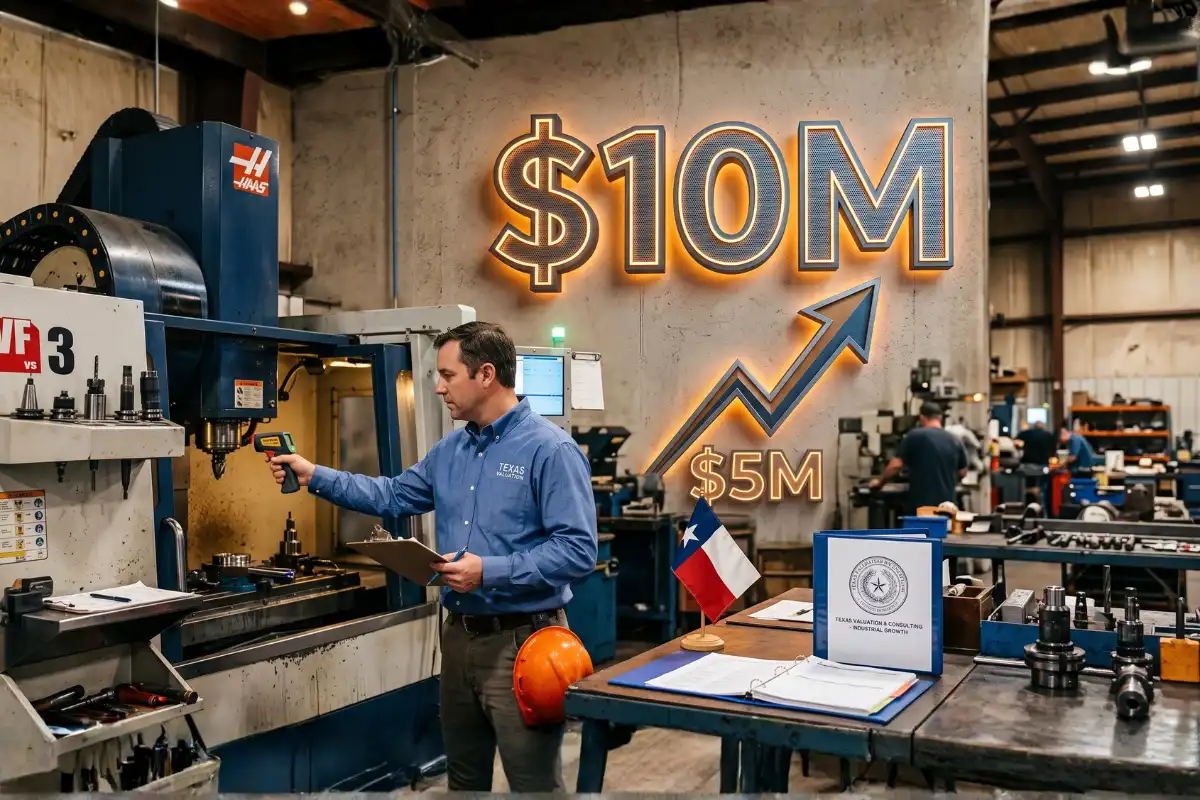
Effective July 4, 2026, the SBA raised the combined 7(a) and 504 loan cap from $5 million to $10 million, the highest level in agency history. Qualified Texas borrowers can now access up to $5 million through the 7(a) program and a separate $5 million through 504, stacked sequentially. The SBA loan limit increase and the 2026 equipment appraisal requirement remain the same, as any equipment collateral at or above $500,000 still requires a USPAP-compliant appraisal reporting the orderly liquidation value. What changed is the size of the loans being structured and, with it, the value of getting that appraisal right. Here we cover what the new rule means, how SBA values your equipment as collateral, when an appraisal is required, and what a lender-ready appraisal report must include.
What Changed on July 4, 2026 (SBA 7(a)/504 Combined Limit)
On July 4, 2026, the SBA raised the combined 7(a) and 504 loan cap from $5 million to $10 million. Any Texas business using equipment as collateral with a value above $500,000 now needs a USPAP-compliant equipment appraisal that reports the orderly liquidation value.
The SBA announced the change on May 18, 2026, and it took effect on July 4. Under SBA Policy Notice 5000-879058, eligible borrowers who first obtain a 7(a) loan can access up to $5 million through 7(a) and up to $5 million through 504, for a combined total of $10 million. That is double the previous $5 million cumulative cap.
Before July 4, 2026, a business with $3 million in 7(a) exposure could only access $2 million more between both programs.
Now that same business can access a full $5 million in 504 financing on top of its 7(a) balance. For Texas equipment-heavy businesses in manufacturing, construction, logistics, and energy, that is a real change.
7(a) vs. 504: How the Two Programs Now Stack Sequentially
The 7(a) loan is the flexible option. The 504 loan is for fixed assets like real estate and long-term equipment. Under the new rule, you use 7(a) first, then layer 504 on top for up to $10 million combined.
| Feature | SBA 7(a) | SBA 504 |
| Best use | Working capital, equipment, acquisitions | Fixed assets: real estate and long-life equipment |
| Max SBA-backed amount | $5 million | $5 million (standard) |
| Rate structure | Variable, prime-linked | Long-term fixed via CDC |
| Used for equipment? | Yes | Yes, long-life machinery |
| Order of access | First | Second, after 7(a) |
The Forbes coverage of the change noted that analysts expect much of the new capacity to flow into equipment and real estate, both of which have gotten significantly more expensive since the last time the SBA cap was raised in 2010.
One Deal, Two Appraisals: What Stacking 7(a) and 504 Actually Requires
Sequencing a 7(a) loan with a 504 loan on the same expansion does not simplify the appraisal side of the transaction – in many cases, it doubles it. Each program carries its own collateral rules, and a borrower financing equipment through 7(a) while financing real estate or long-life machinery through 504 should expect two separate appraisal engagements, not one combined report.
The 504 program requires a full appraisal on the specific project asset being financed. Under 7(a), an appraisal is generally required whenever equipment or machinery serves as collateral above the SBA’s threshold, and many lenders order one even on smaller transactions. Structure a $10 million expansion using both programs, and the loan file can carry two separate appraisal orders running on two separate timelines rather than a single report covering everything.
For a Texas manufacturer financing a $7 million production line through 504 and $3 million in working capital and light equipment through 7(a), that means budgeting for two engagements, two appraiser sign-offs, and two rounds of lender review. Ordering both early, with an appraiser who understands how the two reports need to reconcile with each other, keeps a stacked deal from stalling in underwriting.
Why This Matters for Texas Equipment-Heavy Businesses
Texas leads the country in manufacturing job growth in 2026. A $10 million SBA financing ceiling opens doors for machine shops, fabricators, contractors, and food processors who previously could not structure a full expansion under the old $5 million cap.
Equipment lenders are already positioning for that demand: the Equipment Leasing and Finance Association’s Monthly Confidence Index hit 59.9 in May 2026, signaling expansion momentum in the exact window the new cap took effect.
Businesses most affected by the increase include:
- Metal fabricators and machine shops upgrading CNC equipment lines
- Construction companies financing fleets, cranes, and heavy earthmoving equipment
- Food producers and cold-storage operators buying new processing lines
- Energy and oilfield service companies replacing aged wellsite equipment
- Transportation and logistics companies purchasing trucks and trailers
Manufacturers get an extra lever most other sectors don’t. Under the same SBA policy notice, a small manufacturer can combine an unlimited number of 504 loans, provided each is tied to a distinct project, with a separate $5 million in 7(a) financing for working capital and light equipment. For a Texas metal fabricator running several facility upgrades at once, that structure can exceed the general $10 million combined cap most other industries are working within. The SBA has also waived 7(a) and 504 guarantee fees for manufacturers for fiscal year 2026 and is offering $50 million in grants to organizations that train small manufacturing workers, both of which lower the effective cost of financing the equipment this appraisal guidance applies to.
For Texas sellers looking to exit equipment-intensive businesses, it is worth noting that a growing pool of SBA-backed buyers is changing the liquidity picture for used industrial assets.
See how selling used heavy equipment in Texas through auction versus consignment compares when buyers have more purchasing power.
Not every Texas business needs to think about this. The National Federation of Independent Business has pointed out that most 7(a) borrowers operate well below the old $5 million cap and were never constrained by it in the first place, and groups representing very small businesses note that loans of this size are rarely relevant to a true mom-and-pop operation. The increase matters specifically for capital-intensive, equipment-heavy operations financing a genuine expansion, not for every small business owner reading about the change.
How SBA Loans Value Your Equipment as Collateral
The SBA does not use the value of your equipment to a willing buyer. It uses what a lender could recover in a forced sale. That number is called orderly liquidation value, and it is always lower than fair market value.
| Value Type | Definition | SBA Use |
| Fair Market Value (FMV) | Price between a willing buyer and willing seller, neither compelled | Baseline reference |
| Orderly Liquidation Value (OLV) | Amount recoverable in a reasonable liquidation timeframe, seller compelled to sell | Primary SBA collateral standard |
| Forced Liquidation Value (FLV) | Amount recoverable in an immediate or distressed sale | Worst-case floor |
OLV sits below FMV and above FLV. According to SBA SOP 50 10 8, effective June 1, 2025, lenders apply OLV because, in a default, recovery reflects a liquidation scenario rather than a willing-buyer transaction.
For well-maintained CNC machines or late-model trucks, the gap between FMV and OLV might be 15 to 25 percent. For specialized single-purpose equipment, it can reach 40 percent or more.
New Equipment vs. Used Equipment Collateral Rules
New equipment and used equipment are treated differently under SBA collateral rules. Used equipment requires an orderly liquidation appraisal to unlock the higher advance rate. Without one, you leave borrowing capacity on the table.
Useful Life Comes First: The Eligibility Test Before Value Even Matters
Before a lender calculates advance rates at all, the equipment has to clear a useful-life test. SBA lenders generally require that a piece of equipment’s remaining useful life meet or exceed the term of the loan it secures – commonly a 10-year minimum for a 10-year note.
This test matters more under the new $10 million cap than it did under the old one. A larger loan often comes with a longer term, and a longer term makes the useful-life bar harder to clear. An older CNC machine or aging fleet truck that would comfortably secure a 5-year loan may not have enough remaining service life to back a 10-year note, regardless of what it appraises for today. A qualified appraiser should confirm remaining useful life as part of the same engagement that establishes orderly liquidation value – catching a useful-life shortfall before underwriting saves weeks on a stacked 7(a)/504 deal.
The 50% Net Book Value vs. 80% Orderly Liquidation Value Threshold
Under SBA SOP 50 10 8, used or existing machinery and equipment is valued for the fully-secured calculation as follows:
| Condition | Advance Rate for Fully-Secured Calculation |
| New machinery and equipment | 75% of purchase price minus prior liens |
| Used equipment WITHOUT an OLV appraisal | 50% of net book value minus prior liens |
| Used equipment WITH a USPAP OLV appraisal | 80% of orderly liquidation value minus prior liens |
| Furniture and fixtures (any) | 10% of net book value or appraised value |
The math matters. A piece of used equipment with a $1,000,000 net book value gives you $500,000 toward fully-secured status without an appraisal.
The same equipment with a USPAP OLV appraisal showing $900,000 gives you $720,000. That $220,000 difference can determine whether your loan is approved as structured or requires additional collateral.
When You Need a USPAP-Compliant Equipment Appraisal
Not every SBA loan requires an equipment appraisal. The trigger is the collateral value of the equipment. Once equipment collateral reaches $500,000, an independent USPAP-compliant appraisal is required.
Loan Size Thresholds That Trigger a Required Appraisal ($500,000+)
The $500,000 appraisal threshold applies to equipment collateral valued at $500,000 or more. At that level, the SBA requires an appraisal from a qualified appraiser. The appraisal must be USPAP-compliant and must report orderly liquidation value.
- Additional triggers that require a formal equipment appraisal include:
- Used equipment being purchased from someone other than a licensed equipment dealer
- Equipment being refinanced as part of a 504 loan restructure
- Transactions where equipment forms the primary collateral for the SBA guarantee
- Partner buyouts where machinery and equipment values are contested
What an SBA-Ready Equipment Appraisal Report Includes
An SBA-ready equipment appraisal is not a one-page estimate. It is a structured, USPAP-compliant document that identifies the SBA as an intended user, documents each asset individually, and states the OLV and FMV values separately.
A compliant machinery and equipment appraisal report for SBA lending includes:
- Appraiser credentials and statement of independence from the transaction
- Scope of work and intended use declaration naming the SBA as intended user
- Individual asset identification by make, model, year, serial number, and condition
- Comparable sales data supporting the value conclusion for each asset category
- Separately stated Fair Market Value and Orderly Liquidation Value
- Aggregate values for the machinery and equipment pool as a whole
- Signature and certification by a qualified appraiser
Qualified appraisers for SBA purposes hold recognized designations such as Certified Machinery and Equipment Appraiser (CMEA), Accredited Senior Appraiser (Machinery) from the American Society of Appraisers, or Graduate Personal Property Appraiser (GPPA).
Scott Swenson of Jones Swenson Auctions holds the GPPA designation and conducts USPAP-compliant appraisals for SBA loan files across Texas.
Site-Visit (Summary) vs. Desktop Appraisal Reports
| Report Type | When to Use |
| Summary (Site-Visit) Appraisal | Required when equipment is used, specialized, or unknown. Appraiser physically inspects and verifies each asset. |
| Desktop Appraisal | Acceptable for standard, well-documented equipment. Uses photos, serial numbers, and market data. Faster and lower cost. |
SBA 504 appraisal guidelines specify that used equipment purchased from a non-dealer source requires an on-site inspection appraisal.
Desktop reports are appropriate for standard equipment with good documentation where the lender is confident in asset identification.
Common SBA Equipment Appraisal Mistakes That Delay Loan Closing
The most common equipment appraisal mistakes that halt SBA loan funding include omitting the SBA as an intended user, failing to report orderly liquidation value, and using an unaccredited appraiser.
When dealing with larger capital pools up to $10 million, lender and SBA scrutiny increases dramatically.
A single error on an appraisal report can send the file back to underwriting, delaying your equipment acquisition by weeks.
To ensure a smooth approval under SBA SOP 50 10 8, watch out for these frequent pitfalls:
- Wrong Value Definition: The SBA strictly requires the Orderly Liquidation Value (OLV) for used-equipment collateral. Submitting a report that only states Fair Market Value (FMV) or replacement cost will result in an immediate rejection.
- Missing Intended User Compliance: The appraisal report must explicitly name both the primary lender and the U.S. Small Business Administration as intended users. If the SBA is not named, they cannot legally rely on the document to guarantee the loan.
- Incomplete Asset Detail: Grouping assets under generic descriptions such as “shop tools” or “office equipment” without serial numbers, model numbers, or individual condition ratings will trigger a re-audit.
- Unqualified Appraiser Sign-off: The SBA requires a qualified independent appraiser with recognized industry designations. Using a local equipment dealer or an uncertified technician who lacks USPAP credentials will invalidate the report.
How Long Does an SBA Equipment Appraisal Take? (The 2026 Timeline)
A standard SBA-compliant equipment appraisal typically takes 7 to 14 business days to complete, depending on whether the project requires a physical site visit or a desktop evaluation.
With the 2026 rule allowing sequential stacking of 7(a) and 504 loans, project timelines are more tight than ever. Knowing when to order your appraisal prevents your financing from stalling out at the finish line.
The typical timeline breaks down into three distinct phases:
Phase 1: Information Gathering (Days 1 to 3)
The business owner provides the appraiser with an itemized list of assets, equipment invoices, depreciation schedules, and physical locations.
Delays in gathering serial numbers or proof of ownership during this phase will slow down the entire process.
Phase 2: Inspection and Research (Days 3 to 7)
For a Summary Appraisal, the appraiser travels to the Texas facility to physically verify the machinery’s operational condition.
For a Desktop Appraisal, this time is spent analyzing manufacturer data, market trends, and regional auction sales databases to establish accurate asset baselines.
Phase 3: Valuation and Reporting (Days 7 to 14)
The appraiser applies the required USPAP calculations to determine both the FMV and the critical OLV metrics.
The final certified report is compiled, signed, and delivered directly to the lender for the loan file transaction.
The Bottom Line for Texas Business Owners and Lenders
The SBA loan limit increase, effective July 4, 2026, is the largest expansion of SBA financing capacity in the agency’s history.
For Texas businesses with significant machinery, equipment, and fixed assets, the door to $10 million in combined SBA-backed financing is now open.
The appraisal rules did not change, but the stakes did. With larger loan amounts come more assets serving as collateral, more lender scrutiny, and a greater need for credible USPAP-compliant equipment valuations that will hold up under SBA examination.
Jones Swenson Auctions provides USPAP-compliant equipment appraisals for SBA loan files across Texas.
Scott Swenson holds the Graduate Personal Property Appraiser (GPPA) designation, and all appraisals are conducted in compliance with SBA SOP 50 10 8.
For a no-obligation consultation, call 512-261-3838 (Austin) or 972-387-1110 (Dallas/Fort Worth), or visit to schedule an equipment appraisal or asset services.
Reach out to schedule a consultation!
Frequently Asked Questions for Texas Business Owners and Lenders
When does an SBA loan require a state-certified commercial appraisal?
Under SBA SOP 50 10 8, commercial real estate collateral requires a state-certified appraiser once loan-related real estate value crosses the federal appraisal threshold – cited by SBA lenders as $1 million for commercial real estate transactions specifically. Equipment collateral has its own, lower threshold: a qualified USPAP-compliant appraisal is required once equipment collateral reaches $500,000.
Which industries benefit most from the increase in the SBA loan limit?
Manufacturing, construction, logistics, energy, and food production benefit most because they are capital-intensive and equipment-dependent.
Does a larger SBA loan require a Phase I Environmental Site Assessment?
Yes, when real estate is collateral for loans over $150,000 and environmental risk is present, a Phase I ESA is typically required before closing.
What is the Orderly Liquidation Value, and how does it differ from the Fair Market Value?
OLV is what a compelled seller recovers in a reasonable timeframe. FMV assumes no compulsion. OLV is always lower and is the SBA collateral standard.
Can used equipment fully secure an SBA loan on its own?
Yes, but only with a USPAP-compliant OLV appraisal. Without one, the advance rate drops from 80% of OLV to 50% of net book value.


