

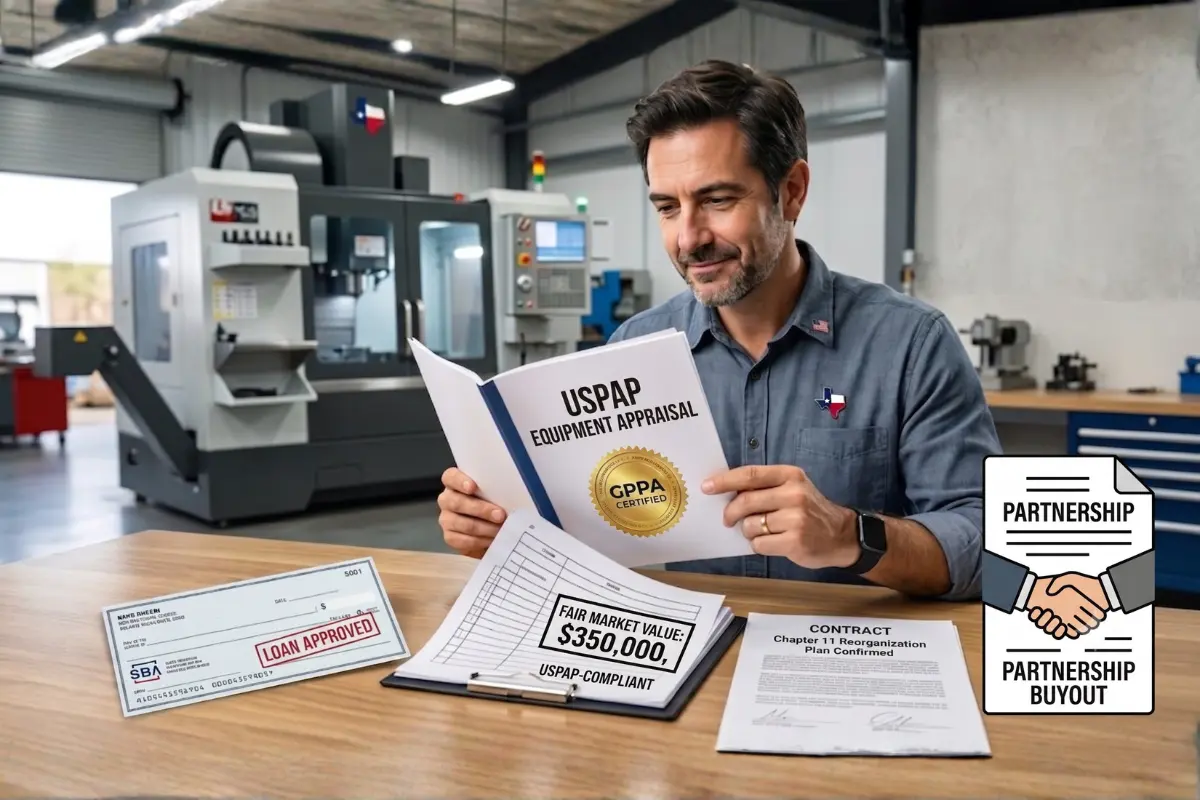
Your equipment has value. But in Texas, that value means nothing on paper unless a certified appraiser puts a defensible number behind it.
Bank loan officers need it before they approve collateral. SBA lenders are required to do so under federal guidelines. Bankruptcy courts rely on it to confirm reorganization plans. And the IRS expects it when equipment changes hands or gets donated above a certain threshold.
A USPAP equipment appraisal is not a formality. It is the document that determines whether your Texas SBA loan gets approved, whether your Chapter 11 plan holds up, and whether your partnership buyout settles without a courtroom fight.
This guide walks you through what USPAP compliance actually means, why it matters at every stage of a business transaction, and how the right certified machinery valuation protects your financial interests from the first lender meeting to the final audit.
The Role of Certified Valuations: Why an Uncertified Appraisal Can Cost You Everything
Here is a scenario that plays out more often than it should: a Texas business owner applies for a $400,000 SBA 7(a) loan backed by manufacturing equipment. The lender orders a valuation from a vendor with no formal credentials. The report comes back, the loan goes to underwriting, and the SBA’s quality-control review kicks it back. Funding delayed. Deal at risk.
The reason? The appraisal was not USPAP-compliant.
USPAP stands for the Uniform Standards of Professional Appraisal Practice. These are the national ethical and performance standards that govern how professional appraisals must be conducted, documented, and reported.
In Texas, a USPAP-compliant machinery and equipment appraisal is the only kind that carries legal and financial weight in a bank’s underwriting file, in a federal courtroom, or in an IRS audit.
An uncertified appraisal is not a discount alternative. It is a liability. Banks reject them. Judges disqualify them. The IRS ignores them. If your equipment is securing a loan, settling a partnership dispute, or being sold in a restructuring, only a USPAP equipment appraisal gives you a number that stands up under scrutiny.
Jones Swenson Auctions has an appraisal arm, FF&E Appraisals. The president, Scott Swenson, holds a Graduate Personal Property Appraiser (GPPA) certification and has guided Texas business owners through certified valuations since 1986. When your deal depends on the number, the credential behind that number matters.
Why SBA 7(a) Lenders Demand USPAP-Compliant Machinery Appraisals
Commercial lenders do not require a USPAP equipment appraisal because they prefer paperwork. They require it because the Small Business Administration (SBA) mandates it.
Under SBA Standard Operating Procedure (SOP) 50 10, lenders participating in the 7(a) and 504 loan programs must obtain credible, independent collateral valuations before approving loans secured by equipment assets.
The SBA’s updated SOP 50 10 8, effective June 1, 2025, reinforces that equipment appraisals must be prepared by a qualified, independent appraiser and must meet recognized professional standards.
Why is this so important to the lender? Because equipment is collateral. If a borrower defaults, the lender needs to know exactly what that equipment is worth, not what the owner thinks it is worth, and not a number pulled from an online listing. The lender needs a documented, defensible value that a federal examiner can review without flagging the loan file.
For Texas businesses, this is especially relevant across industries such as manufacturing construction, agriculture and retail, all asset-heavy sectors where equipment routinely secures mid- to large SBA loans.
What the bank’s underwriter looks for in a USPAP report:
| Requirement | Why It Matters |
| Independence of the appraiser | Eliminates conflict of interest |
| On-site inspection documentation | Confirms physical existence and condition |
| Documented methodology | Supports the value conclusion under audit |
| USPAP compliance statement | Required by SBA SOP and federal FIRREA rules |
| Credentials of the appraiser | Validates the appraiser as a qualified source |
If your Texas SBA loan involves equipment as collateral and the appraisal report does not check every one of these boxes, expect delays, requests for a second opinion, or outright rejection.
The Three Tiers of Commercial Equipment Valuation
Not all equipment values are the same, and that is not a technicality. It is a financial reality that directly affects your loan approval, your restructuring settlement, and your liquidation outcome.
The value of a piece of commercial machinery depends on the time you have to sell it, the market conditions at the time, and the level of financial pressure you are under. Get the wrong tier, and you either leave money on the table or blow up a deal.
There are three recognized standards of value used in Texas commercial equipment appraisals, each addressing a different question.
Fair Market Value (FMV) in Continual Use
Fair Market Value is the price a willing buyer would pay a willing seller when neither is under pressure to complete the transaction. It assumes the business is a going concern, meaning it is actively operating, the equipment is installed and in use, and there is no forced timeline for the sale.
FMV in continual use is the highest of the three value tiers. It accounts for enterprise value, the equipment’s role in the production process, and normal asset depreciation over time. This is the standard most commonly used for:
- SBA loan collateral verification
- Equipment financing and refinancing
- Business acquisitions where the buyer is purchasing a functioning operation
- Insurance coverage documentation
For a Texas manufacturer with a CNC machining center in daily production, FMV in continual use reflects what a buyer would actually pay to acquire that machine as part of an operating facility, not what it would bring at a distressed auction.
Orderly Liquidation Value (OLV)
Orderly Liquidation Value is the amount expected from a sale conducted over a reasonable exposure period of 6 to 9 months, without urgency, using a controlled process like a private treaty sale or a professionally marketed auction.
OLV is lower than FMV because the going-concern assumption is removed. The equipment is being sold as a standalone asset, not as part of an operating business. However, because there is no time pressure, the seller can reach qualified buyers willing to pay a fair price.
This is the standard most relevant to:
- Business closures where the owner has time to plan
- Orderly liquidation value machinery calculations for bank loan workouts
- SBA lender risk assessments on collateral
- Corporate asset disposals during restructuring
OLV is often the value a lender uses to calculate recovery scenarios. If you have a $500,000 loan backed by equipment with an OLV of $350,000, the lender knows the floor on their exposure before approving the credit.
Forced Liquidation Value (FLV)
Forced Liquidation Value is the lowest of the three tiers. It represents the equipment that will be available at an immediate auction, typically within 30 to 60 days. .
FLV is the standard used by:
- Bankruptcy courts assessing debtor estates
- Hard money lenders underwrite asset-based loans
- Receivers managing court-ordered asset disposals
- Creditors calculating recovery in Chapter 7 proceedings
Forced Liquidation Value is appropriate when time is of the essence. This scenario can include the need to vacate a leased space that the business occupies in a timely manner to prevent more expenses.
If you are managing a business wind-down and want to understand how to structure asset sales to avoid forced liquidation outcomes, see our guide on how to liquidate a small business in Texas.
Valuations for Chapter 11 Restructuring and Partnership Buyouts
When a Texas business enters Chapter 11 bankruptcy, the company is not shutting down; it is reorganizing. The goal is to restructure debt while continuing operations.
Equipment valuations in this context serve a very specific legal purpose: they establish the asset base that creditors and the court will use to evaluate the reorganization plan.
The appraiser in a Chapter 11 context carries fiduciary responsibility; their valuation directly influences how creditors get paid, whether the plan is confirmed, and whether secured lenders approve the restructuring terms. An unsupported or non-compliant appraisal can derail a reorganization plan entirely.
The same stakes apply in partnership buyouts. When business partners separate and one is buying out the other’s interest, physical assets, such as equipment, must be valued fairly to achieve equitable distribution. If one partner suspects the appraisal undervalues assets to their disadvantage, that appraisal may be challenged in litigation.
USPAP-compliant valuations are specifically designed to withstand this level of scrutiny. The standard requires the appraiser to document their methodology, identify their data sources, disclose any limitations, and certify their independence, all of which can serve as litigation support if the valuation is challenged in court.
Common scenarios requiring USPAP valuations for restructuring and buyouts:
- Chapter 11 reorganization plans requiring creditor approval
- Machinery valuation for corporate restructuring to negotiate with secured lenders
- Partner exit buyouts where equity is tied to physical assets
- Divorce proceedings involving community property businesses (Texas Family Code applies)
- Estate settlements where business equipment is part of the taxable estate
In each of these, the USPAP appraisal is not optional. It is the document that protects all parties from claims that the value was manipulated.
Defending the Appraisal: IRS Compliance and Litigation
A USPAP equipment appraisal does more than satisfy a lender. It is your defense document against two adversaries you never want to face unprepared: the IRS and opposing counsel in a business dispute.
IRS Compliance: Charitable Deductions and Asset Sales
The IRS maintains strict guidelines regarding when a qualified equipment appraisal is legally required. Moving forward without one can lead to costly audit exposures.
- Donated Equipment Over $5,000: Under IRS Section 170(f)(11), if a business donates commercial kitchen gear, manufacturing machinery, or office systems to a nonprofit during a closure or downsizing, a qualified appraisal is mandatory. The valuation must be completed by an independent, certified appraiser. Using a non-USPAP report gives the IRS direct grounds to disallow your charitable deduction, resulting in unexpected tax liabilities, penalties, and interest.
- Purchase Price Allocation: When buying or selling a Texas business, the total purchase price must be allocated to different asset classes for tax reporting purposes. Buyers rely on these figures to establish accurate depreciation schedules. Without a qualified, USPAP-compliant equipment appraisal to back up the valuation of the machinery class, these allocations are highly vulnerable to IRS challenges.
Litigation and Expert Witness Testimony
When a business dispute heads to a Texas courtroom, whether it is a bitter partnership dissolution, a lender’s lawsuit over a collateral shortfall, or a bankruptcy trustee challenging asset transfers, the appraiser often must serve as an expert witness.
A USPAP-compliant appraisal report is specifically engineered to withstand this intense legal scrutiny. Because the entire valuation process requires clearly cited data sources, fully documented methodologies, and a signed certification of the appraiser’s absolute independence, it leaves opposing counsel with very little room for attack.
Conversely, an appraisal that fails to comply with USPAP standards is a liability. Opposing attorneys can easily exploit gaps in methodology or unverified credentials to have the entire report disqualified before it is even read into the court record.
Summary: How a USPAP Appraisal Protects Your Assets
| Situation | Risk Without a USPAP-Compliant Appraisal |
| SBA Loan Collateral | Underwriting delays, requests for secondary reviews, or outright loan rejection. |
| Donated Equipment (Over $5,000) | The IRS disallows the entire charitable deduction, triggering penalties and back taxes. |
| Chapter 11 Reorganization | Creditors or bankruptcy judges reject the restructuring plan due to unreliable asset valuation. |
| Partnership Buyouts & Disputes | Opposing counsel successfully challenges the asset values, prolonging litigation. |
| Bankruptcy Asset Sales | Trustees or unsecured creditors sue the business owners for alleged asset undervaluation. |
| Tax & Depreciation Reporting | Exposure to IRS audits due to unsupported purchase price allocations across machinery classes. |
How Much Does a Certified Commercial Equipment Appraisal Cost in Texas?
Texas business owners regularly ask this before engaging an appraiser. The honest answer is that cost depends on inventory size, equipment complexity, and the number of assets being appraised. Appraisers are happy to give estimates prior to starting an appraisal project. The cost of a professional USPAP appraisal is usually modest relative to the risk of proceeding without one. A rejected SBA loan, a disallowed IRS deduction, or a challenged buyout valuation can cost multiples of what an accurate appraisal would have cost the first time.
For a free consultation on your Texas equipment appraisal needs, contact Jones Swenson. We will assess your situation, explain which value standard applies, and give you a clear picture of the process before you commit.
Frequently Asked Questions
Why do banks require a USPAP-compliant appraisal for commercial equipment loans in Texas?
Texas commercial banks and SBA lenders are required by federal regulations, including FIRREA and SBA SOP guidelines, to base collateral decisions on credible, independent valuations. USPAP compliance is the recognized standard that satisfies these federal requirements. A non-compliant appraisal exposes the lender to regulatory risk, which is why most banks will not accept it.
What is the difference between Orderly Liquidation Value and Forced Liquidation Value?
Orderly Liquidation Value assumes a 6-to-9-month sale timeline with professional marketing to qualified buyers. Forced Liquidation Value assumes an immediate auction under time pressure, typically within 30 to 60 days. OLV is significantly higher than FLV because more time allows the seller to find buyers willing to pay closer to fair market rates.
How long does a commercial machinery appraisal take to complete in Texas?
A standard USPAP machinery and equipment appraisal for a small-to-mid-size Texas business typically takes 5 to 10 business days from the initial site visit to the delivery of the written report. Complex inventories, litigation-support appraisals, or multi-location facilities may require 2 to 4 weeks. Rush turnarounds are available for time-sensitive transactions at an additional cost.
Will the IRS accept a non-USPAP equipment valuation for a business sale?
No. For donated equipment valued at over $5,000 and for business asset sales subject to purchase price allocation, the IRS requires a qualified appraisal prepared by a qualified appraiser, as defined under Treasury Regulation 1.170A-17. A non-USPAP appraisal from an uncredentialed source does not meet this standard and gives the IRS grounds to disallow deductions or challenge the reported values.
How much does a certified commercial equipment appraisal cost?
For most Texas small business appraisals, costs range from $1,000 to $3,500, depending on the number of assets and the complexity of the inventory. Litigation-support appraisals and expert witness engagements are priced separately based on scope.


