
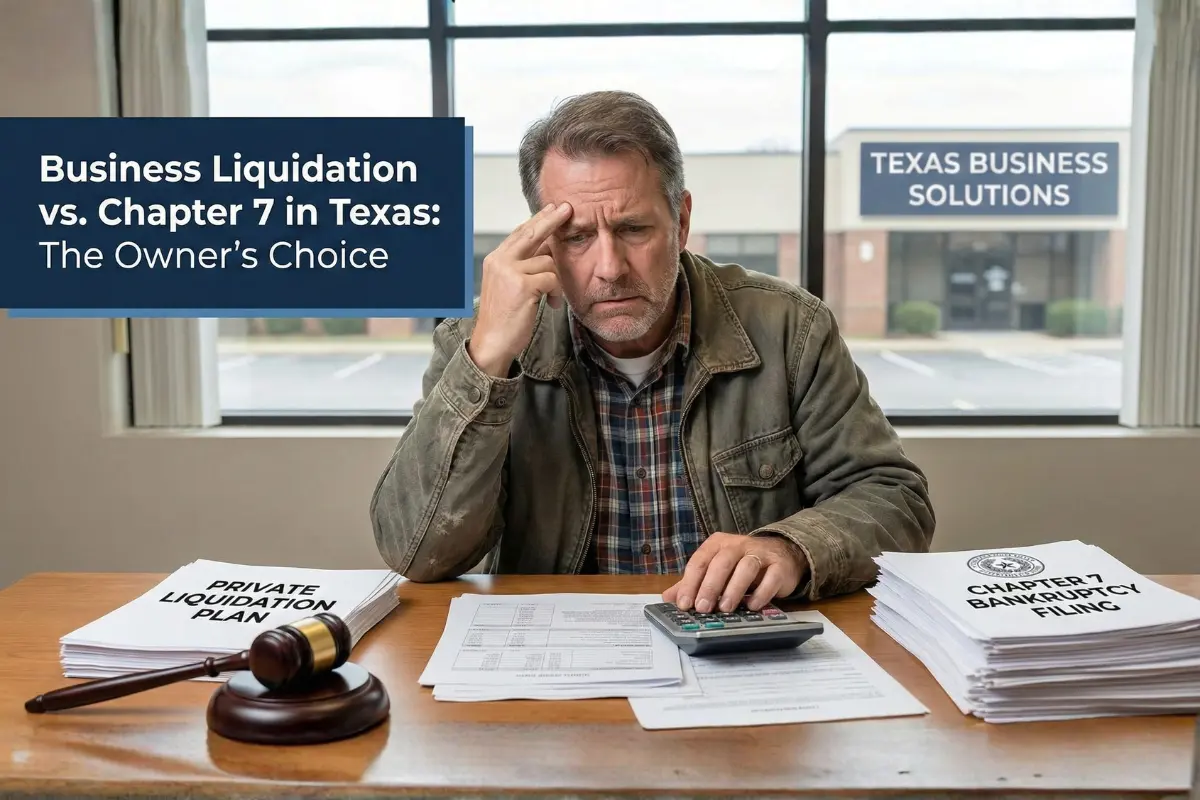
Business Liquidation in Texas (governed by UCC Article 9) and Chapter 7 Bankruptcy (governed by Title 11 U.S. Code) represent the two primary legal paths for corporate insolvency. While Chapter 7 mandates a court-appointed Trustee who prioritizes administrative fees and speed (often resulting in Forced Liquidation Value), a private liquidation allows the business owner to control the sale process. This strategic exit typically achieves Orderly Liquidation Value (OLV), maximizes recovery for creditors, minimizes fiduciary duty risks under the Texas Uniform Fraudulent Transfer Act (TUFTA), and mitigates personal guarantee liability.
For Texas business owners facing insolvency, the choice isn’t just about closing the doors, it’s about how much capital you can save from the fire.
- Private Liquidation (UCC Article 9): A voluntary, owner-controlled process that often yields 20% to 30% higher recovery by targeting market-value buyers.
- Chapter 7 Bankruptcy: A court-supervised process where a federal Trustee controls assets, often prioritizing speed over value to satisfy administrative fees.
This guide analyzes the legal duties, financial outcomes, and “Trustee Traps” associated with corporate winding-up in Texas.
Comparison: Private Liquidation vs. Chapter 7 Bankruptcy
To understand which path protects your remaining capital, we must compare the control, cost, and asset valuation methods of both strategies.
| Feature | Private Liquidation (Strategic Exit) | Chapter 7 Bankruptcy (Court Exit) |
| Legal Framework | UCC Article 9 (Uniform Commercial Code) | Title 11 U.S. Code (Federal Bankruptcy) |
| Control | Owner & Secured Creditors | Court-Appointed Trustee |
| Marketing Method | Global, Targeted Professional Auction | Local “Fire Sale” / Minimal Exposure |
| Asset Value Goal | Orderly Liquidation Value (OLV) | Forced Liquidation Value (FLV) |
| Speed | 30–60 Days | 6–12 Months (Case remains open) |
| Cost Structure | Commission-based (Performance) | Statutory Trustee Fees + Legal Fees |
How Chapter 7 Bankruptcy Works in Texas
The “Trustee Trap” & Administrative Priority
Chapter 7 bankruptcy is a rigid legal mechanism designed to liquidate non-exempt assets to pay creditors based on a strict priority list. In Texas, particularly in the busy Western and Southern Districts, this process removes all control from the business owner.
The Role of the Chapter 7 Trustee
Upon filing, the court appoints a Trustee. This individual has immense power to secure the premises, change locks, and liquidate inventory. However, many owners overlook the inherent conflict of interest in the Trustee’s compensation structure, often called the “Trustee Trap“.
- Commission Bias: Trustees are paid a sliding-scale commission on the funds they distribute. This often incentivizes the quick sale of easy-to-move assets rather than waiting for fair market value.
- Administrative Drain: Before any vendor or secured creditor is paid, the administrative fees, including the Trustee’s own legal counsel, are deducted from the estate.
The Risk of Preferential Transfer Clawbacks
Trustees possess “Avoidance Powers” under the Bankruptcy Code. They can audit your financial history and “claw back” payments made to creditors (vendors) or insiders (family/partners) up to one year prior to filing.
Private Liquidation: The UCC Article 9 Strategic Exit
A private liquidation is a non-judicial alternative that utilizes the Texas UCC Article 9 framework. This section of the Uniform Commercial Code allows a secured creditor (such as your bank) to sell collateral in a “commercially reasonable” manner without court intervention.
Why the “Strategic Exit” Maximizes Value
Unlike a bankruptcy fire sale, a private liquidation conducted by an expert auction firm utilizes a commercial marketing strategy.
- Targeted Audience: Instead of a local sign in the yard, assets are marketed to global buyers who specifically need that equipment.
- Competitive Bidding: A professional auction environment drives prices up toward market value rather than accepting the first lowball offer.
- Fiduciary Compliance: This process satisfies the bank by returning capital faster and proves the owner acted in “good faith,” a critical component of satisfying fiduciary duties during insolvency.
Asset Valuation: Forced (FLV) vs. Orderly (OLV) Liquidation
Understanding the difference between these two valuation metrics is where the real money is recovered or lost.
Forced Liquidation Value (FLV)
This is the “under the hammer” price. It assumes assets must be sold immediately (often within 30 days) to stop expenses like rent. Bankruptcy Trustees typically operate in this zone due to time constraints.
Orderly Liquidation Value (OLV)
This represents the gross amount an asset could fetch given a reasonable time to find the right buyer. According to data from Grant Thornton, assets sold under an “orderly” scenario typically fetch 20% to 30% more than forced scenarios.
The Legal Danger Zone: Fiduciary Duty & Fraudulent Transfers
In Texas, when a company enters the “Zone of Insolvency,” the director’s fiduciary duty shifts legally from the shareholders to the creditors. You become legally responsible for preserving the value of the business assets.
Preventing Fraudulent Transfer Claims (TUFTA)
A major risk for owners is the Texas Uniform Fraudulent Transfer Act (TUFTA). If you sell an asset to a relative or partner for less than its Fair Market Value (e.g., selling a $10,000 truck for $1,000), creditors can sue to reverse the transaction.
The Safe Harbor Solution:
Using a professional auctioneer provides a defense against these claims. Since a public auction is a transparent, competitive market mechanism, the final sale price is deemed “Fair Market Value” by definition.
3 Steps to Execute a Compliant Liquidation in Texas
To avoid court interference and minimize personal liability, follow this structured corporate winding-up path outlined in Texas Business Organizations Code (TBOC) Chapter 11.
Step 1: Secure a GPPA Certified Appraisal
Do not guess asset values. Obtain a certified appraisal from a Graduate Personal Property Appraiser (GPPA). This document establishes the baseline FLV and OLV, serving as your legal shield against claims of asset mismanagement.
Step 2: Execute the UCC Article 9 Sale
Collaborate with your secured creditors. Banks generally prefer this method over bankruptcy because the recovery rate is higher. An auction firm will inventory, market, and sell the assets to clear titles and satisfy liens.
Step 3: Formal Corporate Termination
Once assets are liquidated and debts settled (pro-rata), you must legally dissolve the entity.
- Tax Clearance: Request a Certificate of Account Status (Form 05-359) from the Texas Comptroller of Public Accounts.
- Legal Termination: File Form 651 (Certificate of Termination) with the Texas Secretary of State.
Impact on Personal Guarantees
Can liquidation save your home? In Texas, homestead laws are strong, but Personal Guarantees on bank loans are ironclad.
If a Chapter 7 Trustee sells your assets for pennies (FLV), the bank will likely have a massive “deficiency balance.” They can sue you personally to collect this difference.
The Strategic Advantage:
By achieving Orderly Liquidation Value (OLV) via private auction, you generate more cash to pay down the bank debt. If the debt is fully satisfied, the personal guarantee is extinguished. This protects your personal credit and personal assets from litigation.
Conclusion
Guiding the end of a business requires precision. By choosing Business Liquidation (UCC Article 9) over Chapter 7 Bankruptcy, you maintain control, maximize asset recovery, and significantly reduce legal exposure.
Do not let a court-appointed trustee decide the value of your life’s work.
Jones Swenson has 40 years of experience navigating Texas business owners through the Strategic Exit.
Take the Next Step: Contact us today for a confidential “Asset Viability Assessment” to determine if private liquidation is the right path for your business.
Frequently Asked Questions
Can I sell business assets before filing for Chapter 7 in Texas?
Yes, you can sell assets before filing, provided the sale meets three criteria:
- The sale is for Fair Market Value.
- The proceeds are used for legitimate business expenses or debt payments.
- The transaction is documented (preferably via a professional appraisal).
Selling below market value or to insiders can be prosecuted as a fraudulent transfer.
What is the difference between a UCC Article 9 sale and Chapter 7?
A UCC Article 9 sale is a private, contract-based process managed by the owner and secured lender to maximize value. Chapter 7 is a public, court-supervised liquidation managed by a Trustee, often resulting in lower asset recovery due to administrative fees and forced timelines.
Will I be personally liable for business debts after liquidation?
Liquidation itself does not automatically remove personal liability. However, a strategic liquidation that maximizes asset value (OLV) can often pay off the secured debt entirely. If the bank loan is paid in full, the personal guarantee attached to it is no longer valid.
Is private liquidation faster than bankruptcy?
Yes. A professional private auction can typically be marketed, executed, and settled within 45 to 60 days. In contrast, a Chapter 7 bankruptcy case can remain open for 6 to 12 months while the Trustee investigates financial records and administers claims.


